
ARTICLE 19 is an international think–do organization that propels the freedom of expression movement locally and globally to ensure all people realize the power of their voices. For over 35 years, ARTICLE 19 has worked to ensure that all people can freely express themselves and participate in public life without fear or discrimination. Through research, advocacy, and legal expertise, we advance the rights to freedom of expression and access to information. Our global network operates from nine regional hubs, including offices in Tunisia (MENA), Senegal (West Africa), and Kenya (Eastern Africa).
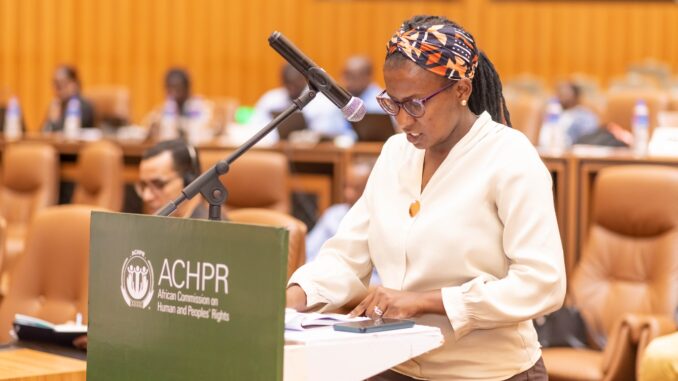
ARTICLE 19 Eastern and West Africa Regional Offices are honoured to address the 85th Session of the African Commission, highlighting the state of freedom of expression, access to information, and civic space protection across Africa. We recognise the progress made, while noting ongoing challenges posed by restrictive state security measures. Notably: –
- ARTICLE 19 welcomes the inclusion of cyberspace in the African Union Convention on Ending Violence Against Women and Girls (CEVAWG) Convention as a recognition of the growing threat of online violence, particularly against journalists, women, and other marginalized groups. However, the Convention’s lack of clear definitions and obligations pertaining to technology-facilitated violence significantly weakens its impact. Across Africa, women and girls face escalating digital harms: non-consensual image sharing, cyberstalking, blackmail, and coordinated harassment often crossing borders and requiring international cooperation. Without specifying what constitutes digital violence or outlining the responsibilities of states and platforms, CEVAWG risks leaving protections vague and unenforceable. We therefore call for a pause in the ratification process to strengthen the Convention’s provisions on digital violence. Adopted in February 2025, the African Union Convention on Ending Violence Against Women and Girls (AU-CEVAWG) is a binding continental framework that obliges States to prevent, address, and eliminate all forms of violence against women and girls across public, private, digital and conflict-affected spheres.
- The African Commission on Human and Peoples’ Rights has adopted Resolutions 620, 630, and 631 in 2024-2025, advancing the right to access data and promoting public-interest content in the digital era.
- Welcomes the adoption of Law No. 2025-15 on Access to Information in August 2025 in Senegal, West Africa.
Freedom of Expression and Access to Information
Despite notable progress, freedom of expression in Africa remains fragile, as the growing convergence of digital repression and shrinking civic space—marked by internet shutdowns, restrictive cybercrime laws, and cross-border repression—continues to silence dissent, endanger journalists and human rights defenders, and undermine democratic principles and obligations under the African Charter. ARTICLE 19 is therefore concerned that:
- In Togo, a constitutional revision in 2025 consolidating executive branch of power has triggered a harsh crackdown on dissent in June to July 2025, with arrests of activists and journalists, violent repression of protests, and restrictions on major social media platforms—undermining free expression and disregarding a decision by the ECOWAS Court of justice ruling against internet shutdowns.
- In Uganda: Journalists in Uganda reported numerous attacks and intimidation: in March 2025, at least 18 journalists covering a by-election were assaulted, and their equipment confiscated by security forces.
- In Bénin, 2025 was marked by regulatory overreach and judicial harassment of media and journalists. The media regulator the Haute Autorité de l’audiovisuel et de la communication (HAAC) suspended six private media outlets in January and Bénin Web TV in March for reporting on the regulator’s own financial management practises.
- In Nigeria, Between May 2023 – May 2025, ARTICLE 19 research documented at least 141 incidents targeting journalists and others civilian actors for peaceful expression, with police and state security services responsible for nearly fifty percent of this cases. In 2025, several journalists were arrested and political actors including arrests in Kano (March), Jos (October), illustrating misuse of cybercrime and public order laws.
- In Kenya, Senegal and other African countries, government authorities have intensified the use of criminal Penal Code and cybercrime laws to prosecute journalists and commentators for alleged “false news,” “immoral speech,” and “insults to state authorities.” These prosecutions underscore the persistent misuse of vague and overly broad laws to silence dissent, contrary to ACHPR Article 9 and the Declaration of Principles on Freedom of Expression in Africa.
- In Guinea, the High Authority for Communication has revoked major broadcast licences and banned critical online platforms, while journalists and commentators face prosecution under vague laws on “false news” and “incitement.” Opposition figures and activists, including Oumar Sylla and Mamadou Bah, have been abducted or detained incommunicado, fueling fear and repression. Authorities repeatedly blocked social media during periods of unrest, most recently during the September 2025 referendum.
In light of the above, we, therefore recommend that:
- The Commission should urge member states to protect journalists by ensuring accountability for those in custody, conducting independent investigations into attacks, and adopting measures to prevent future threats to media freedom.
- States should develop national action plans for the safety of journalists. In addition, the safety of journalists should be integrated into national sustainable development strategies under the 2030 Agenda for Sustainable Development;
- Request urgent communications to the governments of Togo, Kenya, Bénin, Uganda, Côte d’Ivoire, Mali, Tanzania, Burkina Faso, Niger, Nigeria and Senegal on cases for journalists and activists; seeking remedial measures in line with Charter obligations.
- Mandate the Special Rapporteur on Freedom of Expression and Access to Information to conduct country visits in Eastern and West Africa regions, with a focus on shutdowns, protest policing and political party restrictions.
- Urge States to repeal or amend speech restrictive provisions to comply with the Declaration of Principles and ICCPR Articles 19, 21 and 22.
- Call for an end to internet shutdowns and platform blocking, with public transparency, judicial oversight, and strict application of legality, necessity and proportionality tests.
Freedom of Association and Political Participation
The freedom of political association is recognized as a fundamental right essential to democracy, good governance, and citizen participation. The African Charter on Human and Peoples’ Rights (Article 10 & 13) and national laws guarantee the right to freely form and join political parties, requiring States to promote political pluralism, inclusive participation, and protection of opposition voices in a peaceful and rights-respecting environment.
But despite common understanding as to the need for protection of freedom of association, we are concerned that protection of freedom of political participation is still elusive, for example:
- Mali: Escalating political suppression with political parties dissolution, abductions, incommunicado detentions and enforced disappearances targeting journalists, political activists, human rights defenders and even local state officials undermining numerous rights including the rights to liberty and physical security, freedom of expression and opinion, freedom of association and assembly, access information and political participation, in contravention to the ICCPR, the ACHPR, the ICPPED and Principles and Guidelines on Human and Peoples’ Rights while Countering Terrorism in Africa
- Uganda: In November 2024, Dr. Kizza Besigye, a long-time political rival of President Museveni, was unlawfully arrested in Kenya, renditioned to Uganda, and charged before a military court with treachery and illegal firearm possession – charges widely viewed as politically motivated. Alongside fellow opposition leader Mr. Obeid Lutale, he has remained in detention for nearly six months. The opposition National Unity Platform (NUP) has also faced repeated police suspensions of its gatherings, reflecting ongoing restrictions on political activity and freedom of assembly. On 1st October 2025, two Kenyan activists Bob Njagi and Nicholas Oyoo were abducted in Uganda while attending an opposition campaign event; they have not been presented before any court of law and their whereabouts are unknown to date.
- Tanzania: From 10th April 2025, the main opposition party, CHADEMA, was disqualified from upcoming general elections for not signing a required code of conduct, which the party deemed unconstitutional. Mr. Lissu, the runner-up in the country’s 2020 presidential election, was charged with treason over what prosecutors said was a speech calling on the public to rebel and disrupt the election due in October 2025. He was not allowed to enter a plea on the treason charge. On 15 September 2025, the electoral commission disqualified opposition leader Luhaga Mpina for running in the October 2025 elections. Mr. Mpina, who heads the Alliance for Change and Transparency (ACT) – Wazalendo, had been cleared to contest the presidency following a High Court ruling overturning his initial disqualification by the Tanzania electoral commission. CHADEMA and ACT Wazalendo are currently disqualified from participating in the 29th October 2025 general elections.
- Benin: Law enforcement authorities also pursued cross-border repression when Beninese journalist Comlan Hugues Sossoukpè, a recognised refugee in Togo, was arrested in Abidjan on 10 July and extradited to Cotonou, where he faces charges including “harassment by electronic means” and “apology for terrorism”.
- South Sudan: South Sudan’s first vice-president and main opposition leader, Riek Machar, has been placed under house arrest from March 2025 to date. There were reports from July 2024 indicating that Machar has been confined to Juba and was not permitted to travel outside the country. As of April 2025, several South Sudanese opposition leaders and activists are experiencing severe repression, including arbitrary arrests, torture, media censorship, and travel restrictions.
- Kenya: State authorities have increasingly used terrorism charges to suppress political dissent, with protesters and youth leaders from opposition movements accused under the Prevention of Terrorism Act following anti-government demonstrations in June 2025. Cases such as activist/journalist/political candidate Boniface Mwangi, opposition youth leader Wanjiku Thiga, and over 30 protesters charged in 2025 highlight growing concern that counter-terrorism laws are being misapplied to silence dissent.
- Ethiopia: Since 2023, the ongoing ethnic conflicts in Amhara and Oromia have led to a militarized political environment while opposition figures such as Bekele Gerba and Eskinder Nega have faced repeated detentions.
- Côte d’Ivoire: Ahead of the 25 October 2025 presidential elections, ARTICLE 19 reported mass arrests during opposition protests, concerns over candidate exclusions, mounting restrictions on assembly and expression, intimidation and online harassment of journalists, notably M’ma Camara of France24, and raised alarms over the arrest and transfer of Beninese refugee journalist Sossoukpè from Abidjan to Cotonou.
- Alliance of Sahel States (AES): Across military-led transitions, civic space has drastically narrowed. In Mali, authorities dissolved political parties and suspended political activity, while critics and activists faced enforced disappearance and harassment; media were sanctioned for protest coverage. A joint FIDH/OMCT report details a regional convergence of repressive practices, arbitrary arrests, abductions, torture, media suspensions and protest ban across Mali, Burkina Faso, Niger and Chad.
In light of the above, ARTICLE 19 recommends that:
- States to reform and harmonize national laws to align with regional and international standards, ensuring that registration, operation, and participation of political parties and movements are free from discrimination or undue state interference.
- States to end the misuse of security, anti-money laundering and counter-terrorism laws to target dissenting voices, and establish independent oversight mechanisms to hold authorities accountable for violations of civil and political rights.
- States to promote inclusive civic and political participationof women, youth, and marginalized groups in political processes through capacity building, civic education, and equitable access to political platforms and decision-making spaces.
Human Rights Protection and National Security
Human rights belong at the heart of all national security efforts, or these efforts risk exacerbating the very conditions conducive to violence, insecurity or becoming sources of rights violations themselves.
- Mr. Chairperson, national security laws in the region often lack clear definitions and contain vague provisions that allow broad and subjective interpretation by authorities. The growing politicization of security agencies and the ambiguous application of laws on national security, public order, and public safety have enabled arbitrary enforcement, fostering impunity and weakening accountability.
- There is growing concern over the use of emerging and existing technologies in counter-terrorism efforts, including covert digital surveillance, facial and emotion recognition, and internet shutdowns or website blocking under the pretext of national security, which risk undermining privacy and civil liberties.
- Existing national oversight mechanisms intended to promote accountability; have been undermined by compromised independence, inadequate resourcing, and the politicisation of security institutions, which have collectively limited their impact.
We call upon the Chairperson of the African Commission to urge the governments within the region to:
- Review and align security laws and surveillance practices with international human rights standards to ensure transparency, accountability, effective oversight, and proportional use of surveillance technologies, while guaranteeing access to remedies for individuals adversely affected by their misuse.
- Support the implementation of recommendations from regional human rights mechanisms, including the Universal Periodic Review and the African Commission on Human and Peoples’ Rights, by ensuring follow-up during sessions, mandating relevant committees to propose actions, and monitoring progress by the Executive.
Presented to the ACHPR Commission by ARTICLE 19 West and Eastern Africa in October 2025.